
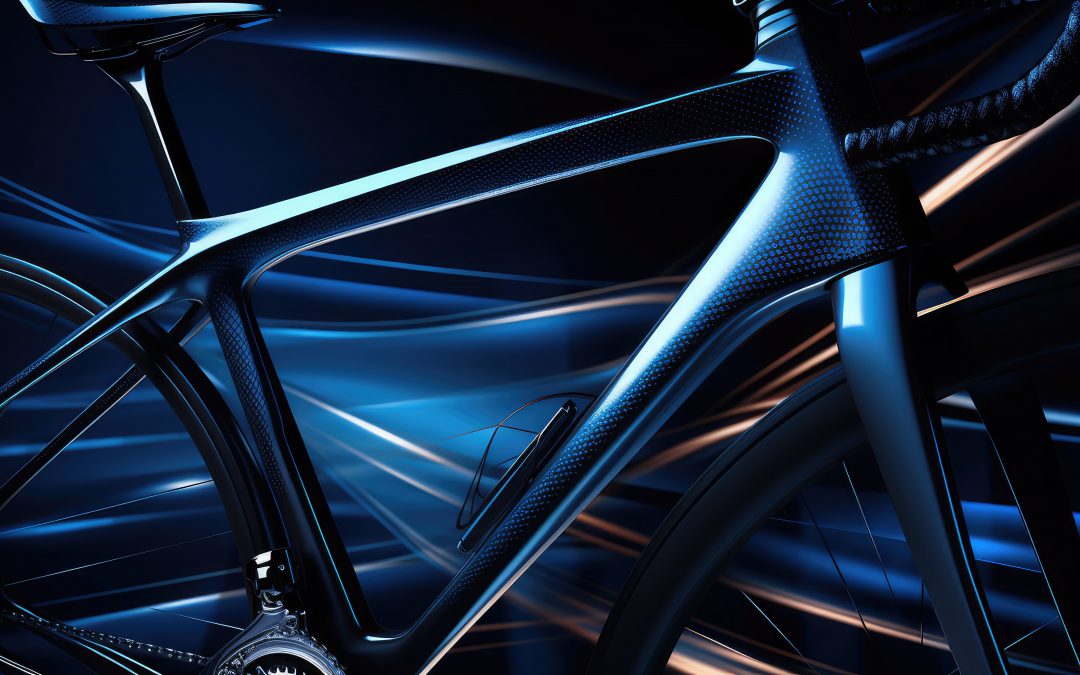
The bicycle industry is undergoing a period of profound transformation. Demand for high-performance bicycles and electric bicycles is growing steadily, driven by sustainable mobility, high-level sport and technological innovation. However, this growth is accompanied by significant industrial, technological and logistical challenges that require new solutions.
In this context, composite materials, and in particular carbon fibre, play a key role, as does the automation of manufacturing processes. At Fidamc, we work precisely at this intersection between design, advanced manufacturing and quality control.
Carbon fibre: lightness, performance and design
Carbon fibre has established itself as the benchmark material for high-performance bicycles thanks to its key advantages:
- Weight reduction, essential for improving efficiency and performance.
- Aerodynamic optimisation, allowing for more advanced designs.
- High mechanical performance, with an excellent stiffness-to-weight ratio.
- Design freedom, resulting in frames and components with high aesthetic value.
Currently, much of the manufacturing of carbon fibre bicycles takes place in Asia, which poses challenges in terms of supply chain, logistics costs and time to market.
Automation: towards closer, more efficient and competitive manufacturing
One of the major challenges facing the sector is to bring manufacturing closer to Europe without losing competitiveness. At Fidamc, we are working on the development of automated manufacturing processes for composite materials applied to the bicycle sector, with several clear objectives:
- Reduce dependence on distant supply chains.
- Improve quality control traceability of the product
- Shorten design-to-market times, accelerating innovation.
- Reduce costs, facilitating access to composite bicycles for a wider market.
Automation is not just about replicating manual processes, but rather specifically designing components and structures that harness the full potential of these technologies, integrating requirements for lightness, performance, attractive design and cost from the outset.
Comprehensive expertise in composite materials
Fidamc brings comprehensive knowledge of carbon fibre to the bicycle sector, covering all stages of development:
- Design and structural optimisation.
- Automated manufacturing processes.
- Laboratory, testing and quality control, ensuring that components meet the standards required by manufacturers.
- Development and validation of new materials and processes, anticipating the future needs of the sector.
In addition, we collaborate with manufacturers and developers by conducting specific tests to ensure the reliability, safety and durability of components.
Collaborative projects to promote sustainable mobility
A recent example of this collaboration is the BIELA project, led by AIRTIFICIAL, with the support of CDTI Innovation and the collaboration of FIDAMC.This project focuses on the development of advanced structural components for bicycles, using:
- State-of-the-art composite materials.
- Automated manufacturing technologies.
- A clear focus on sustainable mobility and high performance.
This type of initiative strengthens technology transfer between sectors such as aerospace and cycling, and opens the door to a potential entry into the market with the support of key players.
Looking to the future of the sector
The bicycle of the future will be lighter, more efficient, more sustainable and more accessible. Overcoming current challenges requires combining advanced materials, automation, quality control and intelligent design.
At Fidamc, we continue to work to ensure that innovation in composite materials and advanced manufacturing processes is a real driver of competitiveness for the bicycle industry, promoting manufacturing that is closer, more efficient and aligned with the mobility challenges of tomorrow.
 English
  Spanish
Trackbacks/Pingbacks