Adhoc Training
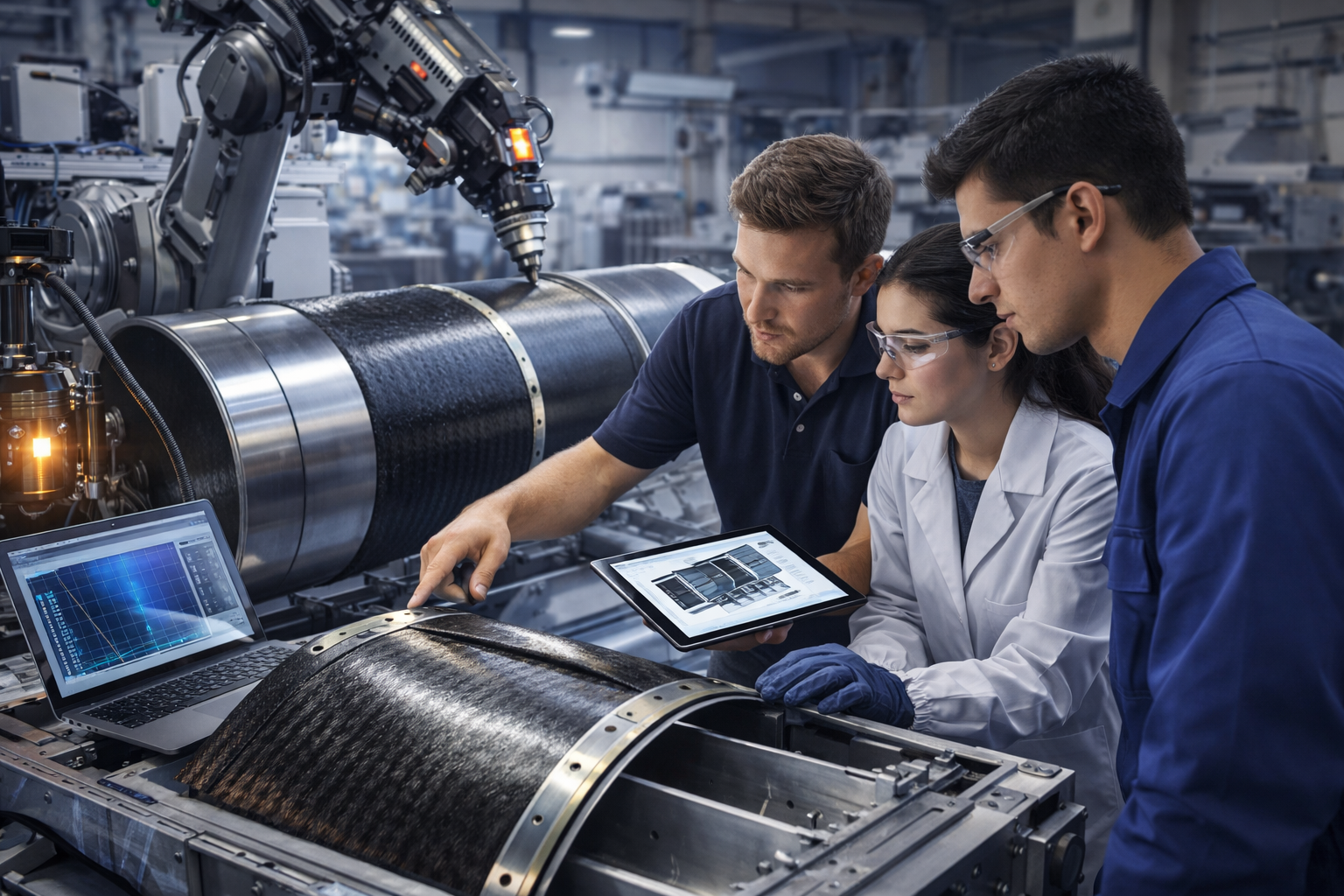
We design each programme on a case-by-case basis, working closely with our clients to identify their specific needs. Training content, depth, and methodology are fully adapted to the profile of the participants, the industrial sector and the technologies and processes involved, ensuring maximum relevance and impact.
- Specialised Technical Programmes
- Materials and processes: thermoset and thermoplastic composites, manual and automated lamination, AFP/ATL processes, curing and consolidation
- Assembly and installation: aeronautical structures, assembly techniques, aeronautical sealing
- Repairs: structural repair of composites, damage assessment
- Testing and quality: non-destructive testing (NDT), physical-chemical and mechanical characterisation, quality assurance
- Metrology: dimensional, geometric control, industrial techniques and equipment
- Digitisation and automation: collaborative robotics, programming applied to manufacturing, additive manufacturing, CATIA and simulation
Benefits for companies that train their employees at Fidamc Tech Academy
- Improved work performance
The specialised training offered by FIDAMC enables workers to acquire advanced technical knowledge and practical skills in industrial processes, composite materials and innovative technologies. This translates into more confident, efficient and autonomous employees who are capable of making better decisions in their workplace and adapting quickly to new production challenges.
- Reduction of production errors
With better trained staff, errors resulting from poor handling of materials, incorrect use of machinery or misinterpretation of processes are minimised. FIDAMC training helps to standardise procedures, improve quality control and reduce rework, waste and costs associated with technical errors.
- Optimized delivery times
Improved operational efficiency and fewer incidents during production make processes smoother and more predictable. This facilitates meeting delivery deadlines, improves project planning, and increases customer satisfaction, which is key in highly competitive sectors.
- Increased innovation and competitiveness
Training in an advanced technological environment such as FIDAMC fosters a culture of innovation within the company. Trained employees are better equipped to propose improvements, implement new technologies and actively participate in R&D projects, strengthening the company's position in the market.
- Talent retention and motivation
Investing in employee training demonstrates a clear commitment to their professional development. This increases staff motivation, commitment and loyalty, reducing turnover and consolidating stronger, more qualified work teams.
Customization process:
- Analysis of company needs
First, an initial assessment is carried out to identify the company's objectives, the profile of its employees, their level of prior knowledge, and the technical or production challenges facing the organisation. This analysis makes it possible to detect specific training gaps and define which skills need to be reinforced.
- Design of a customized training program
Based on the preliminary analysis, a fully customised training plan is designed. The most relevant technical content is selected, the level of depth is adjusted, and the modules that add the most value to the company's activity are defined, ensuring that the training is aligned with its processes and technologies.
- Adaptation of methodology and format
The training is tailored not only in terms of content, but also in terms of methodology: face-to-face sessions, practical training in real environments, online training or hybrid models. Likewise, the duration, timetables and pace of learning are adjusted to minimise the impact on the company's productive activity.
- Practical implementation and support
Throughout the course, priority is given to a practical and applied approach, using real cases and situations typical of the company's working environment. In addition, technical support is provided to answer questions and facilitate the transfer of knowledge to the workplace.
- Evaluation and continuous improvement
Finally, the results of the training are evaluated using indicators such as the level of learning, the application of the knowledge acquired, and the impact on productivity. Based on this evaluation, adjustments and improvements are made for future training activities, ensuring effective and evolving training.
Other information for companies:
- Target professional profiles for the courses: technicians and operators. The training programs are tailored to the client’s needs.
- Training Formats
- In-person
Training is mainly delivered in person, allowing for practical, hands-on learning in real industrial environments, with access to equipment, laboratories and advanced technologies. This approach facilitates the acquisition of technical skills that can be immediately applied in the workplace.
- Flexible schedules, adapted to the company’s
Schedules are flexible and adapt to the availability of the company and its employees. They can be programmed for full or part-time work, adjusting to work shifts and avoiding interference with normal production activities.
- Training can be delivered in English and Spanish
Training courses can be delivered in Spanish and English, allowing international teams to participate and facilitating the training of personnel from companies with a global reach.
- Course duration varies depending on the content and the required level of specialization.
The duration of the courses varies depending on the content and level of specialisation required. They can range from short, intensive training courses lasting a few days to more extensive programmes structured in several modules, always with a practical and results-oriented approach.
 English
  Spanish