Innovation in the aerospace sector does not originate solely with the major manufacturers. An increasing number of start-ups and SMEs are developing new materials, manufacturing processes, components or technologies with the potential to transform the industry.
However, the path from a good idea to a product capable of flying is a complex one. Validating materials, manufacturing prototypes, carrying out tests, scaling up processes or meeting the sector’s demanding quality requirements calls for infrastructure, knowledge and experience that few companies can manage on their own.
It is precisely at this point that a technology centre such as FIDAMC offers distinctive value.
Much more than just a laboratory
When people talk about a laboratory they usually think of test tubes, microscopes or materials testing. But in the aerospace sector, a laboratory must be much more than that.
At FIDAMC, the laboratory forms part of a technological ecosystem where engineering, advanced manufacturing, automation, validation and production coexist. The aim is not merely to verify that a technology works, but to ensure that it can be manufactured in a repeatable, safe and industrially viable manner.
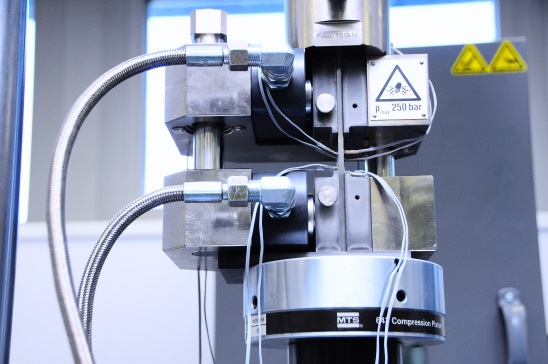
For this reason, in addition to material characterisation and physical, chemical and mechanical testing, the laboratory is involved in process validation, quality control and the development of new technologies that will subsequently be incorporated into industrial programmes.
The challenge facing start-ups: proving that an idea can be turned into a product
Many start-ups are founded on disruptive technology, but few have the necessary resources to demonstrate that this innovation can be manufactured on an industrial scale.
The transition from the initial prototype to an industry-ready solution is often one of the biggest hurdles for any start-up.
It is necessary to validate materials, optimise processes, manufacture demonstrators, carry out testing programmes and generate the technical evidence needed to convince future customers or investors.
FIDAMC acts precisely as that environment where technologies can mature before reaching the market, reducing technical risks and accelerating their industrial development. This is a philosophy that the centre has been applying since its inception as a bridge between research and industry.
A partner for industrial SMEs
The reality for many SMEs in the sector is different, but their challenges are similar.
They have experience in manufacturing or engineering, but need to incorporate new processes, automate part of their production or develop products using composite materials without making major investments in equipment.
In such cases, FIDAMC makes its engineering, laboratory, advanced manufacturing and validation capabilities available to companies so that they can develop new solutions without bearing the full technological risk.
This collaborative model enables companies to access cutting-edge technologies, accelerate their R&D projects and reduce the time needed to bring an innovation to market.
A space for collaboration
During a recent working meeting at the centre, an idea emerged that sums up FIDAMC’s philosophy very well: to act as a meeting point between materials manufacturers, machinery developers, industrial companies and end customers.
Rather than competing with companies, the aim is to complement their capabilities.
FIDAMC contributes its production facilities, laboratory, engineering expertise and experience so that different organisations can jointly develop solutions that none of them could tackle on their own. Collaboration models are even being promoted in which equipment manufacturers install their technologies at the centre’s facilities so that they can be used by companies and validated in real industrial environments.
From the laboratory to industry
A technology does not generate value until it can be produced to a high standard, with repeatability and at competitive costs.
That is why FIDAMC’s work does not end when a test yields good results.
The next step involves developing manufacturing processes, automation, quality control and industrialisation to transform that innovation into a viable product for the market.
This approach makes the centre a strategic partner both for start-ups needing to demonstrate their technology and for SMEs seeking to boost their competitiveness through innovation.
Building the aerospace ecosystem of the future
The aerospace industry is evolving towards an increasingly collaborative model, where major manufacturers, start-ups, SMEs, universities and technology centres work together to accelerate innovation.
Within this ecosystem, FIDAMC plays a key role as a technology accelerator, facilitating the transformation of knowledge into industrial solutions capable of reaching the market.
Because innovation is not just about having a good idea.
It is about having the right knowledge, capabilities and environment to turn that idea into an industrial reality.
 English
 Spanish