The transformation of the aerospace industry towards lighter, more efficient and more sustainable structures is driving constant evolution in advanced composite materials. In this context, two major technological families account for a large part of current industrial development: thermoset composites and thermoplastics.
At FIDAMC, we work on the development, validation and industrialisation of both technologies, collaborating with aerospace manufacturers and suppliers to accelerate their integration into future aviation programmes.
Although both types of composite materials share many advantages over traditional metallic materials, their properties, manufacturing processes and industrial applications differ significantly. Understanding these differences is key to grasping the direction in which aerospace manufacturing is evolving.
What are thermoset composites?
Thermoset composites are typically made up of carbon fibres combined with thermosetting resins, such as epoxy resins. During the manufacturing process, these resins undergo an irreversible chemical reaction when subjected to heat and pressure. Once the material has cured, its structure is permanently fixed.
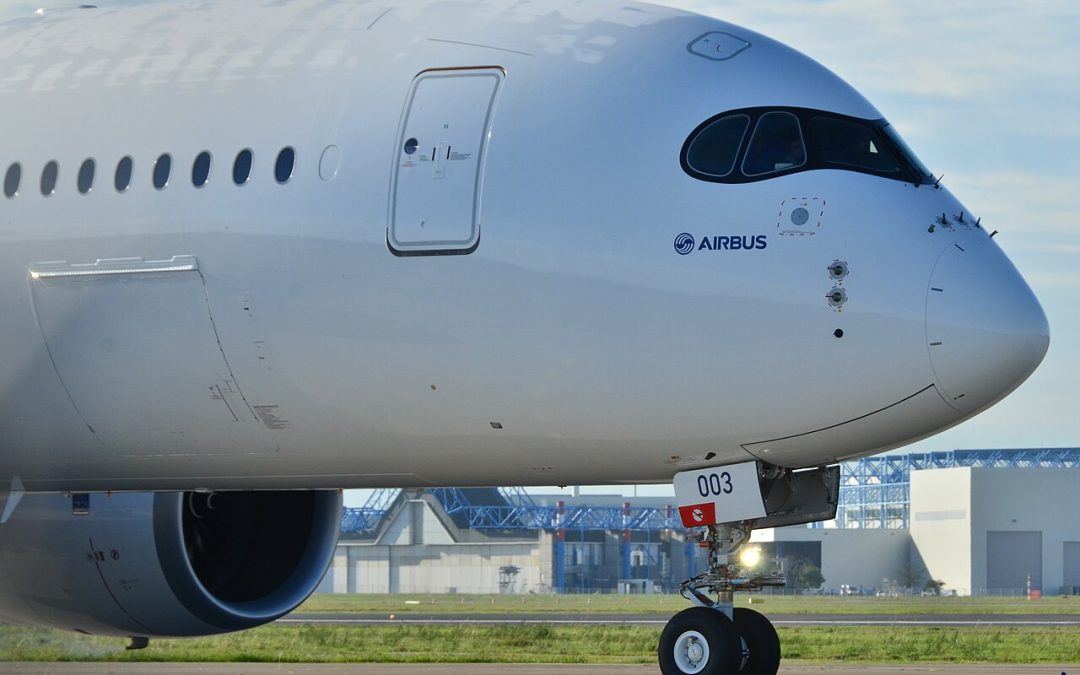
Currently, thermoset composites represent the most established and widely used solution in commercial aviation. Aircraft programmes such as the Airbus A350 XWB make extensive use of these materials in primary structures subject to high loads.
Main advantages of thermosets:
- High structural performance
Thermoset composites offer an excellent strength-to-weight ratio and very robust behaviour under complex structural loads.
- High industrial maturity
These technologies are widely certified and validated within the aeronautical sector.
There is a wealth of accumulated experience in design, manufacture and maintenance.
- Good thermal and chemical behaviour
Thermosetting resins exhibit good thermal stability and chemical resistance, aspects that are particularly important in aerospace applications.
Main limitations of thermosets
- Lengthy manufacturing processes
Many components require complex curing cycles, often in an autoclave, resulting in long production times.
- Greater difficulty in recycling
As these materials have an irreversible chemical structure, their reuse and recyclability are subject to greater limitations.
- More complex repairs
Repair operations usually require specific procedures and take a relatively long time.
What are thermoplastic composites?
Thermoplastic composites also use reinforcing fibres, but employ thermoplastic matrices rather than thermosetting resins. The main difference is that these materials can be melted and reshaped by applying heat.
This opens up new possibilities from an industrial perspective. In recent years, thermoplastic materials have attracted enormous interest in the aviation sector due to their potential to increase productivity, automation and sustainability.
Key advantages of thermoplastics
- Faster processes
Unlike thermosets, thermoplastics do not require long chemical curing cycles.
This allows for a significant reduction in manufacturing times.
- Greater potential for automation
Thermoplastic processes are particularly well-suited to automated manufacturing, advanced welding and high-speed production.
- Better recyclability
As they can be reshaped using heat, they offer significant advantages in terms of the circular economy and sustainability.
- High impact resistance
Many thermoplastic composites exhibit very favourable behaviour when subjected to impact and damage.
Main limitations of thermoplastics
- Technically demanding processes
Manufacturing requires very precise control of temperature, pressure and compaction.
- Lower level of industrial maturity in certain applications
Although development is progressing rapidly, many structural applications are still dominated by thermoset solutions.
- Material and equipment costs
Some thermoplastic solutions still involve high costs associated with raw materials and manufacturing systems.
Where are they currently used?
In aviation, both technologies coexist and serve different purposes.
Common applications of thermosets
Thermoset composites continue to predominate in:
- Wings.
- Fuselages.
- Primary structures.
- Structural panels.
- Tail sections.
- High-responsibility components.
Their high level of maturity and certified track record make them the primary solution for many critical structures.
Common applications of thermoplastics
Meanwhile, thermoplastic materials are seeing particular growth in:
- Clips and structural supports.
- Interior components.
- Secondary elements.
- Smaller structures.
- Welded joints.
- High-throughput production applications.
Furthermore, there are an increasing number of developments aimed at future primary structures.
The industrial challenge: manufacturing faster and more sustainably
One of the major challenges facing the aeronautics industry today is to increase production rates whilst maintaining the quality standards demanded by the sector. In this context, thermoplastic materials are attracting enormous strategic interest. Their potential to reduce manufacturing times and facilitate automation could prove crucial for future generations of aircraft.
However, thermosetting materials will continue to play a leading role for many years to come due to their technological maturity and structural performance. Consequently, the future of the sector does not necessarily lie in completely replacing one technology with another. The most likely trend will be the coexistence of both solutions, depending on the type of application and industrial requirements.
FIDAMC’s role in this evolution
At FIDAMC, we work precisely within this environment of technological transition. Our work focuses on:
- Development of automated processes.
- Validation of advanced technologies.
- Industrialisation of composites.
- Robotic manufacturing.
- Digital process monitoring.
- Optimisation of cycle times.
- Integration of new sustainable solutions.
Whether working with thermoset or thermoplastic materials, one of the main challenges is not merely to demonstrate that a technology works, but to ensure that it can be manufactured in a repeatable, stable and economically viable manner.
A practical example: automation and welding in thermoplastic composites
A typical example of the kind of work we carry out is research into automated manufacturing and joining processes for thermoplastic structures. Unlike many thermosetting composites, certain thermoplastic materials allow joints to be formed using advanced welding techniques rather than traditional mechanical fastenings.
This can offer significant advantages such as weight reduction:
- Fewer components.
- Processes that are more easily automated.
- Shorter assembly times.
However, new industrial challenges also arise:
- Thermal control of the process.
- Quality of consolidation.
- Inspection of joints.
- Structural validation.
- Industrial scale-up.
At FIDAMC, we are specifically working on validating these types of technologies in environments close to actual production, helping to reduce risks prior to their industrial implementation.
Where is aviation heading?
The aviation of the future will require more efficient, sustainable and productive aircraft.
To achieve these objectives, the evolution of composite materials will be crucial.
The main trends point towards:
- Greater automation in manufacturing.
- Increased use of thermoplastics.
- More sustainable processes.
- Industrial digitalisation.
- Integration of artificial intelligence and advanced monitoring.
- New assembly and joining methods.
At the same time, thermoset composites will continue to evolve with new resins, improved curing processes and more efficient manufacturing technologies. Rather than direct competition between technologies, the future is likely to be characterised by hybrid solutions and manufacturing strategies tailored to each specific aerospace requirement.
At FIDAMC, we will continue to work towards accelerating this transition, helping to transform technological innovation into real industrial capacity for the aerospace sector.
 English
 Spanish